
Beyond the Headlines: Fed Rate Hikes and Long-Term Portfolios
Janet Yellen, the former Federal Reserve Chair, often said that "monetary policy is not a panacea."1 Just as there is no cure for the common cold, except to let it run its course and address the symptoms, the Fed’s tools often cannot fix the underlying issues in the economy. In theory, monetary policy is meant to help ease these challenges, especially when it comes to the job market and inflation. In practice, however, the Fed does not control the economy directly, but instead responds to the economic environment.
Today, the primary challenge is stubborn inflation. For the most part, this is due to higher oil prices as the war in Iran continues, prolonging the closure of the Strait of Hormuz and other issues in the region. Clearly, the Fed cannot control these geopolitical issues with interest rate policy. However, they can try to ensure that inflation does not spread beyond energy prices into other categories that affect consumers and businesses. How does seeing the Fed through this lens affect long-term investors and their portfolios?
The Fed's latest rate hike was anticipated by investors
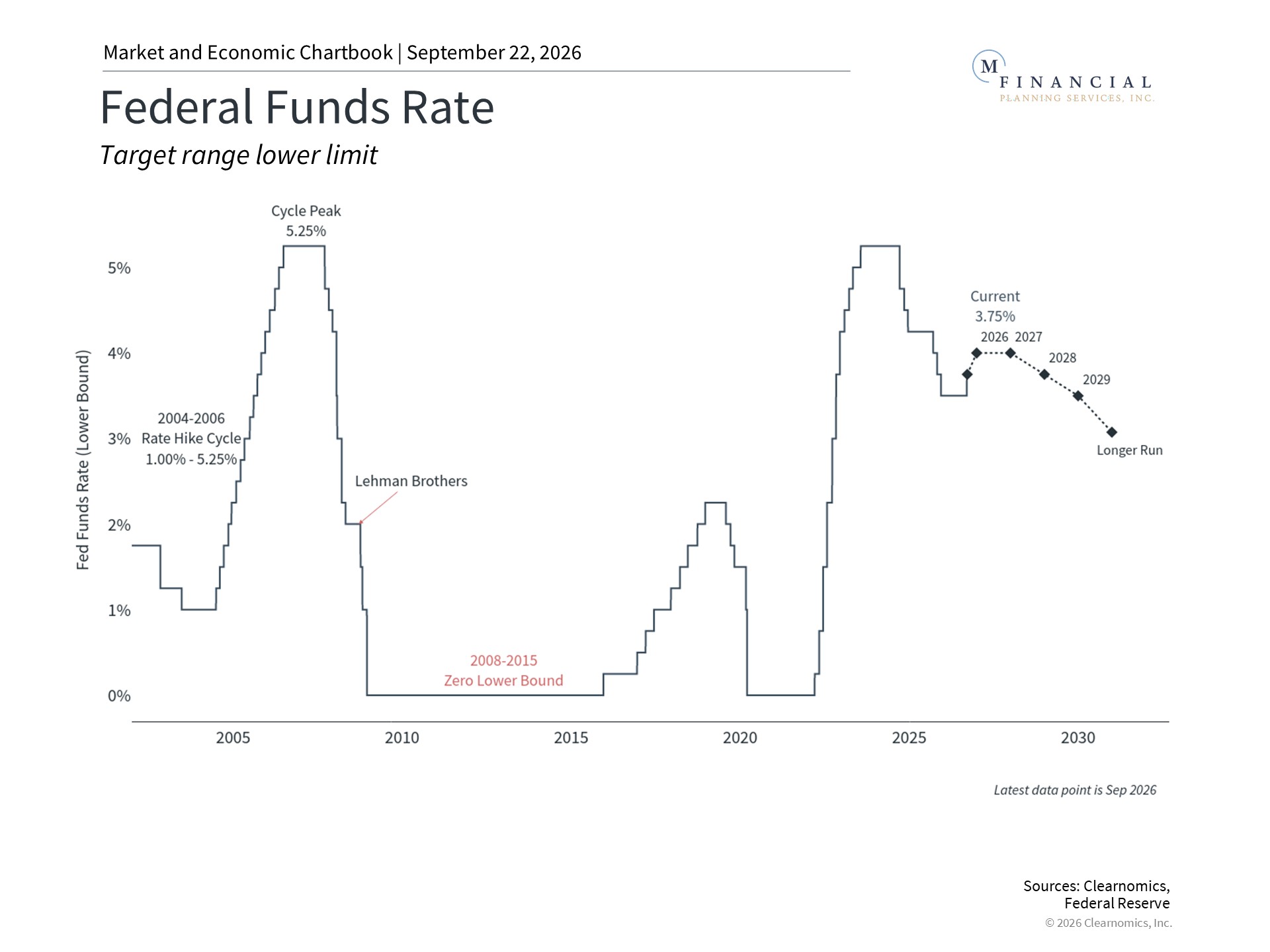
At its September meeting, the Fed decided to raise policy rates by one-quarter of a percent, to a range of 3.75% to 4.00%. This was the first hike in three years and followed a period of rate cuts from September 2024 to December 2025. This decision was widely anticipated by investors, so while there were some market swings immediately after the announcement, the market took the move in stride overall.2
What makes this hike different? The Fed is mostly reacting to higher energy prices, particularly with oil still around $100 per barrel. Economists often refer to this as “cost-push inflation,” which simply means that supply disruptions have led to higher prices. This is in contrast to “demand-pull inflation,” which occurs when an overheating economy drives excessive consumer demand, which then pushes prices higher.
In 2022, for instance, the economy experienced both scenarios, with low interest rates and government stimulus driving inflation on the demand side, while supply disruptions due to the pandemic and Russia's invasion of Ukraine led to supply shocks. Typically, economists and policymakers view supply-side shocks as temporary, since they should eventually be resolved. In the case of oil, prices did eventually fall until this year’s geopolitical events.
Over the past few cycles, the Fed has preferred to change policy in a steady, well-communicated fashion. This practice, often referred to as "forward guidance," was designed to provide clarity on the likely path of rates, especially during economic emergencies. New Fed Chair Kevin Warsh, however, prefers to avoid this approach, and has declined to submit his own forecasts to the Fed’s quarterly Summary of Economic Projections.3
Instead, his goal is for markets to react to the underlying data, not what the Fed will do next. This is one reason investors expected this rate hike with over a 90% probability prior to the Fed meeting.4 Regardless of whether this is the right or wrong approach, this means the underlying data, when it comes to the labor market, inflation, and growth, are even more important for understanding the environment. While inflation remains higher than many would prefer, unemployment is still historically low, and GDP growth has been steady.
Rate hikes are a normal part of the economic cycle
This is one reason the Fed only raised rates by 0.25%. At the moment, projections by other Fed officials suggest that the central bank could raise rates once more later this year before pausing through 2027. Then rates might only decline slowly from there. This is a change from the Fed’s previous forecasts in June when they believed rates would be lower. At the same time, it’s important to take these figures with a grain of salt since they can quickly change from meeting to meeting depending on the underlying economic trends.
It's understandable that some investors view higher interest rates as being negative for markets. In reality, this depends on why the Fed is raising rates. It’s not at all unusual for markets and interest rates to move higher together, especially later in the business cycle.
For instance, a growing economy and strong corporate earnings can support both rising stock prices and a Fed that is trying to keep inflation in check. Over the past six months, major indices including the S&P 500, the Dow Jones Industrial Average, and the Nasdaq have all moved toward new all-time highs, supported by strong corporate earnings and the buildout of AI data centers, even as interest rates have also risen to multi-decade highs.
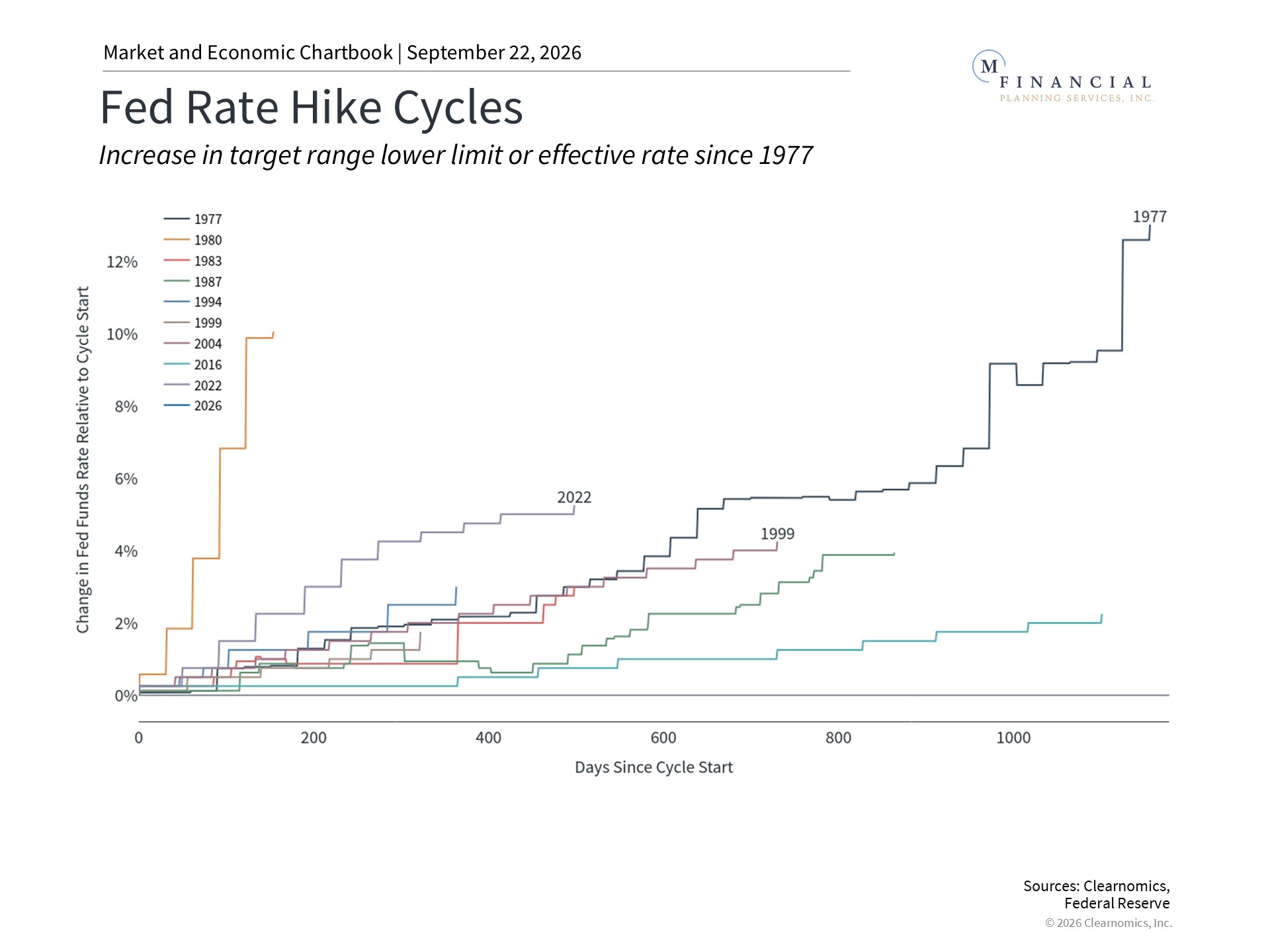
There is also a misconception that the Fed’s role is to fine-tune the economy. This view was partly created by the Fed itself, especially during Alan Greenspan’s tenure from the late-1980s to the mid-2000s, when the Fed’s decisions were opaque. In practice, the Fed is more often reacting to events than sitting comfortably in the driver's seat. The chart above shows how rate hikes have played out across many different environments, underscoring that these rate moves often occur over long cycles.
Staying invested is the best way to address inflation in the long run
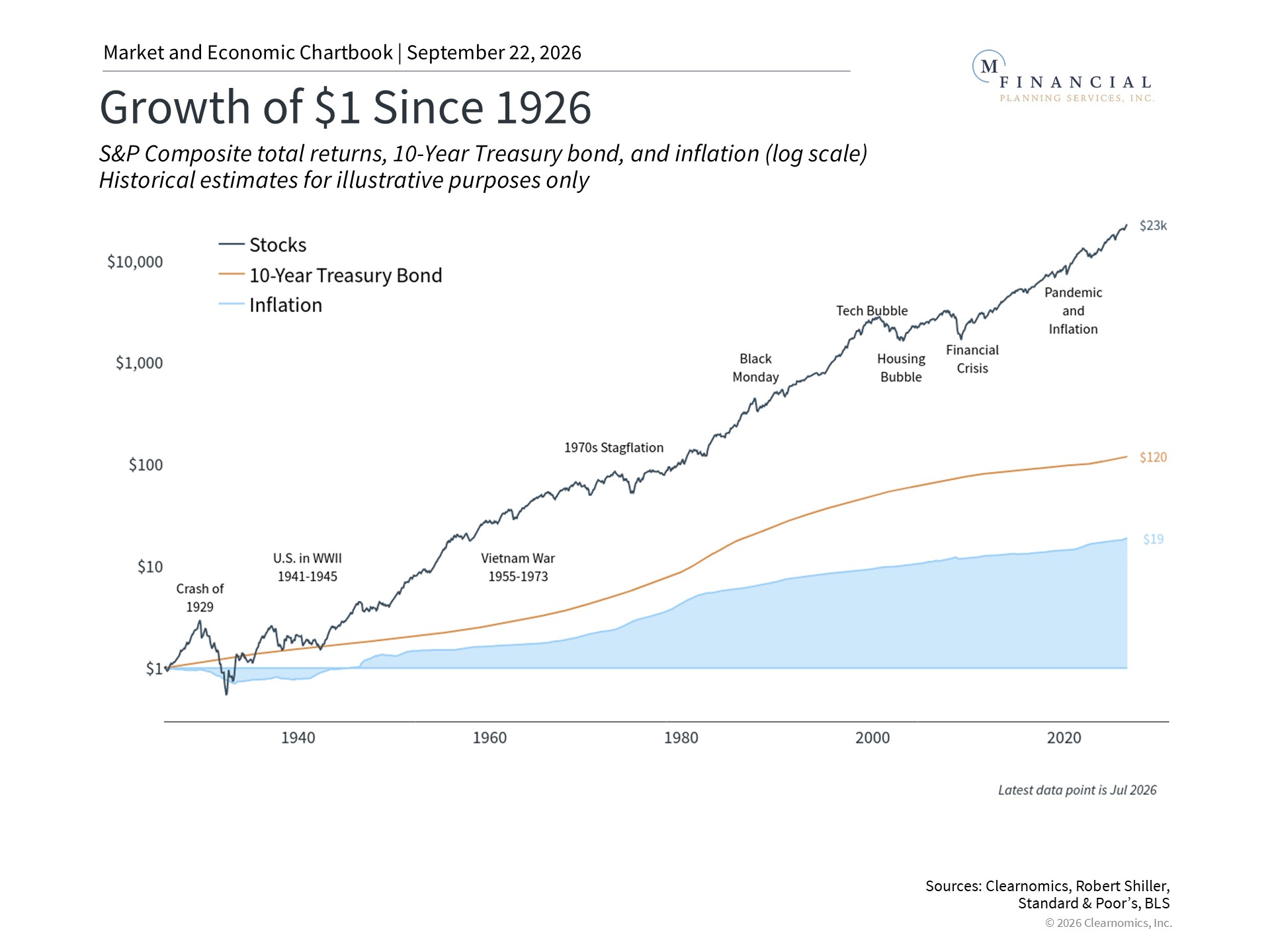
Ultimately, investors care about Fed policy and interest rates because of the impact on their portfolios and financial plans. While the Fed attracts a great deal of attention, its decisions are only one part of the picture.
The accompanying chart shows how financial markets have supported investors over the past century despite countless Fed decisions, economic shocks, recessions, geopolitical challenges, and other events that were significant at the time. Throughout this period, inflation pushed costs higher by 19 times, so what used to cost $1 in 1926 now costs $19. Despite this, stocks and bonds both significantly outpaced inflation rates. For those who stayed invested, this supported portfolios to generate income and create wealth over time.5
Of course, markets never move in straight lines, and investors should always be prepared for uncertainty. This is why maintaining an appropriate portfolio that reflects long-term financial plans remains far more important than trying to predict or time the Fed’s next decision.
The bottom line? The Fed's latest rate hike reflects inflation due to higher oil prices. Investors are best served by focusing on long-term goals and maintaining balanced portfolios rather than reacting to each Fed decision.
References
1. https://www.federalreserve.gov/newsevents/speech/yellen20170303a.htm
2. https://www.federalreserve.gov/monetarypolicy/files/monetary20260916a1.pdf
3. https://www.federalreserve.gov/newsevents/speech/warsh20260828a.htm
4. Clearnomics research and CME Group data, as of September 16, 2026
5. Clearnomics research using Bureau of Labor Statistics and Standard & Poor’s data, as of September 18, 2026
Index Descriptions
S&P 500
The Standard & Poor’s 500 Index is a capitalization-weighted index of 500 stocks designed to measure performance of the broad domestic economy through changes in the aggregate market value of 500 stocks representing all major industries. The modern design of the S&P 500 stock index was first launched in 1957. Performance prior to 1957 incorporates the performance of the predecessor index, the S&P 90.
Securities and advisory services offered through LPL Financial, a registered investment advisor. Member FINRA / SIPC. Financial planning offered through M Financial Planning Services, a Registered Investment Advisor and a separate entity.
This material is for general information only and is not intended to provide specific advice or recommendations for any individual. There is no assurance that the views or strategies discussed are suitable for all investors or will yield positive outcomes. Investing involves risks including possible loss of principal. No investment strategy or risk management technique can guarantee return or eliminate risk in all market environments Any economic forecasts set forth may not develop as predicted and are subject to change.
References to markets, asset classes, and sectors are generally regarding the corresponding market index. Indexes are unmanaged statistical composites and cannot be invested into directly. Index performance is not indicative of the performance of any investment and do not reflect fees, expenses, or sales charges. All performance referenced is historical and is no guarantee of future results.
This information is not intended to be a substitute for specific individualized tax or legal advice. We suggest that you discuss your specific situation with a qualified tax or legal professional.
Bonds are subject to market and interest rate risk if sold prior to maturity. Bond values will decline as interest rates rise and bonds are subject to availability and change in price.
U.S. Treasury securities are guaranteed by the federal government as to the timely payment of principal and interest. The principal value of Treasury securities and other bonds fluctuates with market conditions.
International investments carry additional risks, which include differences in financial reporting standards, currency exchange rates, political risks unique to a specific country, foreign taxes and regulations, and the potential for illiquid markets. These factors may result in greater share price volatility.
This material was prepared by Clearnomics, Inc., who is not affiliated with the named financial professional, firm or broker/dealer.