

The recent Moody's downgrade of U.S. government debt from Aaa to Aa1 marks the end of America's perfect credit rating. With this decision, all three major rating agencies (Standard & Poor's in 2011, Fitch in 2023, and now Moody's) have lowered the nation's credit status. This comes as lawmakers debate budget legislation that could increase government borrowing, highlighting tensions between tax policies and financial stability. Many investors are wondering how these developments might affect their savings and investments.
Budget talks often create market uncertainty

Over the past 15 years, government budget negotiations have repeatedly caused market swings. Examples include Standard & Poor's 2011 credit downgrade, the 2013 fiscal cliff, and government shutdowns in 2018-2019. Despite these disruptions, agreements were eventually reached and markets recovered each time.
Interestingly, even after the first-ever downgrade in 2011 and subsequent market drop, stocks recovered within months. Though it might seem strange, U.S. Treasury bonds remain considered safe investments during uncertain times, despite these rating changes.
While we should be concerned as citizens about the country's financial path, these issues shouldn't cause panic in your investment approach. Previous fiscal challenges caused temporary uncertainty, but markets have consistently stabilized over time. Focusing on long-term investment goals rather than reacting to headlines from Washington remains the wisest strategy.
Moody's announcement comes as investors shift focus from trade tariffs to the new budget proposal. In explaining their decision, Moody's stated that "successive US administrations and Congress have failed to agree on measures to reverse the trend of large annual fiscal deficits and growing interest costs."
Tax cuts likely to continue
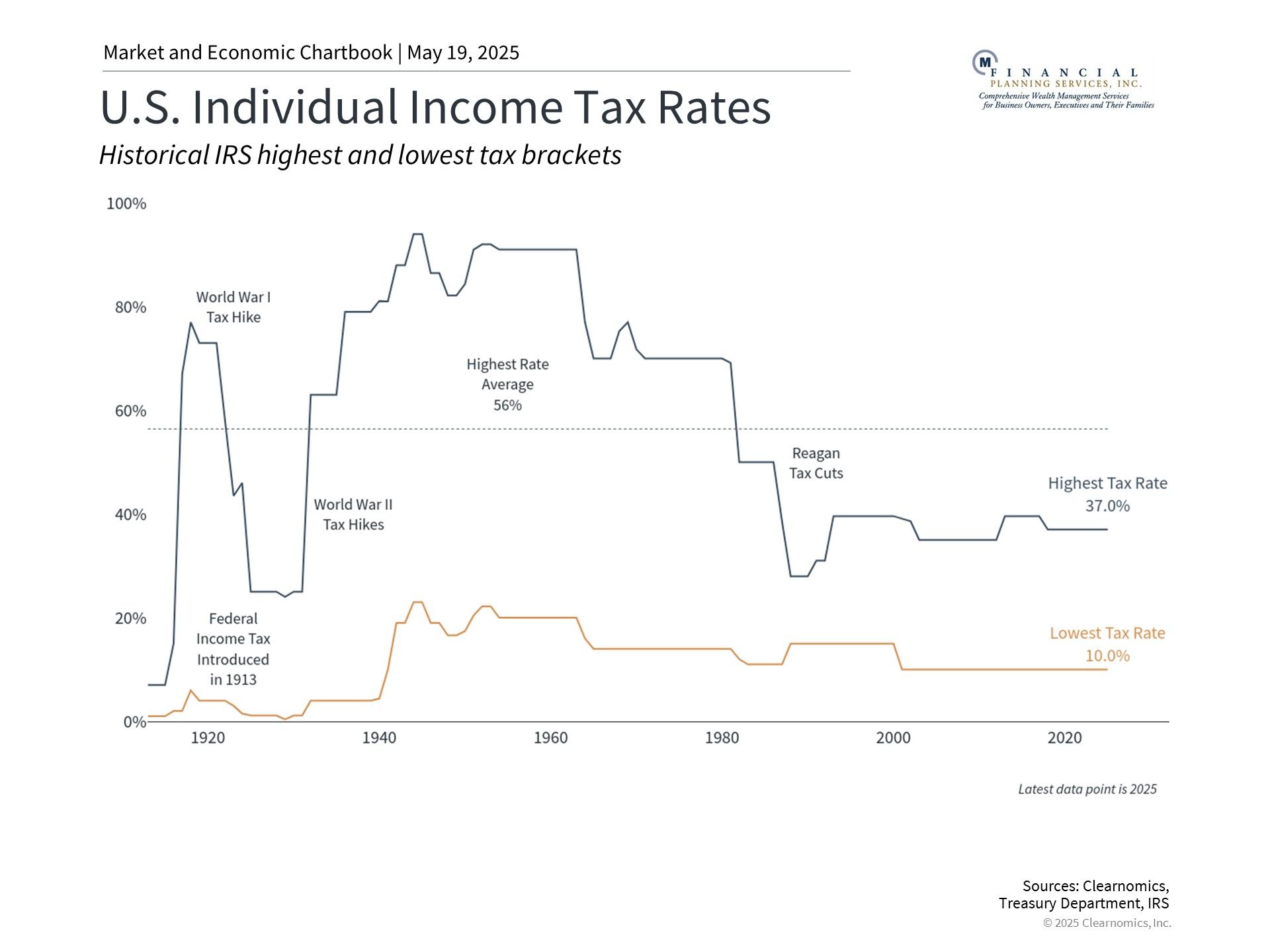
Congress is currently working on a budget bill that would extend tax cuts from the Tax Cuts and Jobs Act, which would otherwise expire after 2025. This aims to avoid a "tax cliff" where rates would suddenly increase to pre-2017 levels. By addressing these issues well before the deadline, lawmakers hope to create stability for households and businesses.
The proposed tax package includes several key provisions for both individuals and businesses:
For Individuals:
- Making the current tax rates permanent (top rate of 37%)
- Increasing the child tax credit from $2,000 to $2,500 through 2028
- Possibly raising the state and local tax deduction limit from $10,000 to $30,000
- Making tips and overtime pay tax-free through 2028
- Making auto loan interest tax-deductible through 2028
- Creating new savings accounts for children under 8
For Businesses:
- Increasing and making permanent the pass-through business deduction
- Reinstating full business equipment write-offs for 2025-2029
- Bringing back research and development tax breaks
Government borrowing continues to grow

While the budget proposal includes about $1.6 trillion in spending cuts to programs like Medicaid, these reductions are outweighed by tax cuts and spending increases elsewhere.
The national debt already exceeds $36 trillion—about $106,000 per American. Reports suggest the new budget could add roughly $3 trillion more over ten years, with one congressional estimate putting that figure at $3.7 trillion.
The challenge is that most federal spending goes to mandatory programs like Social Security and Medicare, making significant cuts politically difficult. This leads some to worry that tax rates may eventually need to rise, despite current extensions.
The bottom line? While the U.S. credit downgrade highlights concerns about the country's financial future, history shows that investors who stay focused on their long-term plans—rather than reacting to government debt headlines—typically achieve better results.