

Artificial intelligence (AI) continues to dominate financial headlines, with markets reaching new highs and investors asking a familiar question: Are we in another bubble, like the dot-com era?
It’s a fair concern—and one worth unpacking.
What’s Driving the AI Surge
Major corporations are spending trillions on AI projects, including data centers, advanced chips, and teams of AI researchers. Some of these arrangements are deeply interconnected—Nvidia, for example, has invested billions in OpenAI, which in turn purchases Nvidia’s hardware.
While this level of spending raises eyebrows, it also highlights a key reality: AI requires enormous infrastructure, collaboration, and capital. The question is whether these investments will ultimately deliver enough value to justify their cost.
Growth vs. Bubble: Why It’s Hard to Tell in Real Time
It’s always easy to recognize a bubble in hindsight. During the late 1990s, companies with little or no revenue were valued in the billions. But not every period of rapid growth is a bubble.
A decade ago, many worried that spending on cloud computing was excessive. Today, it’s the backbone of modern business. The same may prove true for AI.
Another distinction is that many of today’s AI leaders—such as Google, Meta, Microsoft, and others in the so-called “Magnificent 7”—are established, profitable companies with strong balance sheets. That stability matters.
Lessons from History
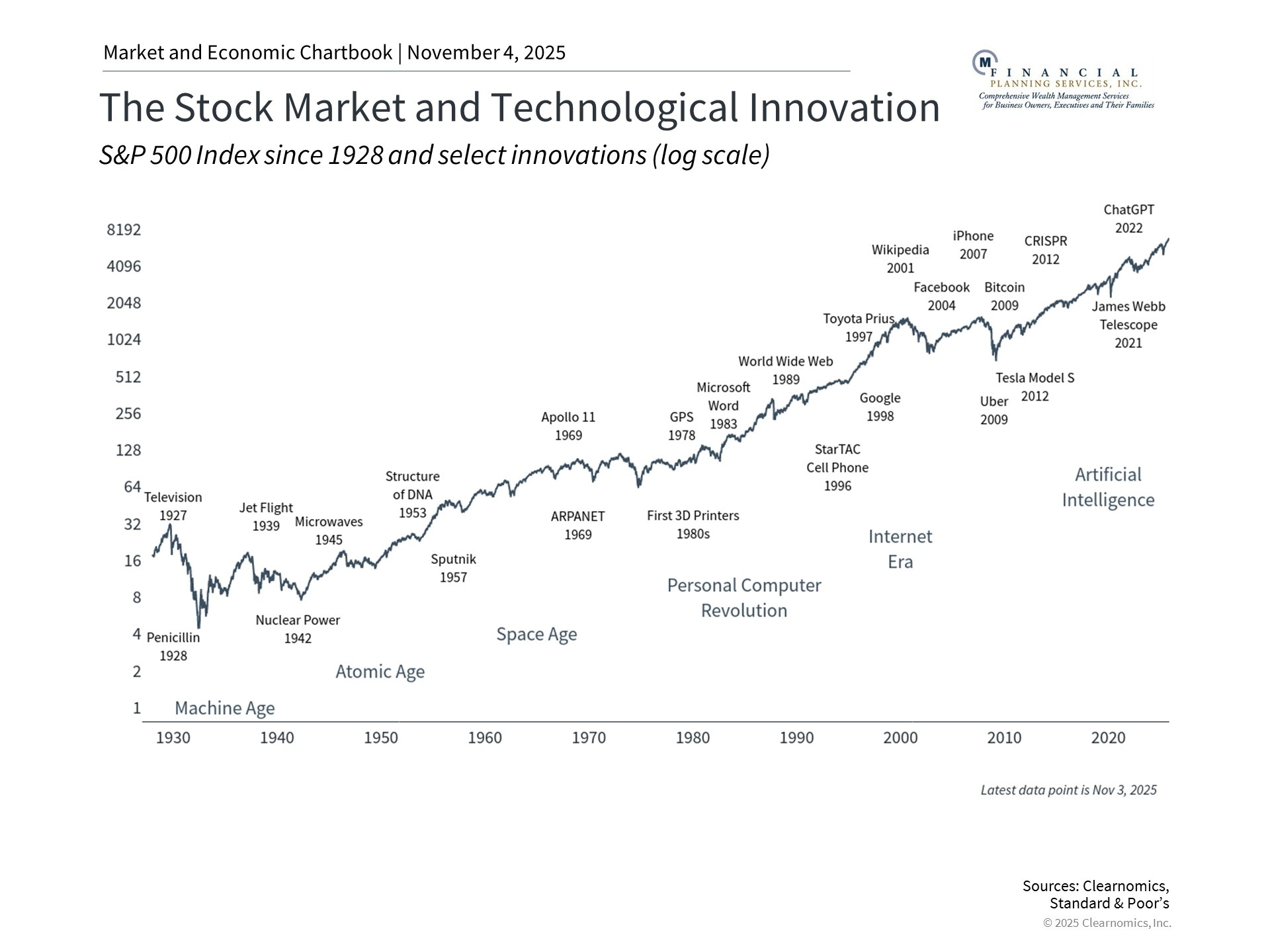
Technological revolutions rarely follow a straight line. The railroad expansion of the 1800s, the spread of electricity, the “tronics” boom of the mid-1900s, and the rise of the internet all began with extraordinary optimism, followed by sharp corrections—and eventually, enduring transformation.
Amazon’s story is a prime example—it lost 95% of its value during the dot-com crash, only to become one of the most successful companies in history.
The lesson: innovation often takes longer to deliver returns than investors expect, but the long-term impact can be profound.
What This Means for Your Portfolio
With the S&P 500’s price-to-earnings ratio near historic highs, markets are currently reflecting expectations for future growth. That doesn’t mean it’s time to retreat—it means it’s time to stay disciplined.
Here’s how we approach it:
- Participate in innovation—prudently. Your portfolio is designed to benefit from long-term technological progress, including AI, while maintaining balance across sectors and asset classes.
- Diversify to manage risk. Concentration in any single trend—no matter how exciting—creates unnecessary exposure. Diversification helps preserve progress when markets shift.
- Stay focused on your goals. Your financial plan is built to capture opportunity and manage risk over decades, not months. That’s how we keep your strategy aligned with your life and long-term objectives.
The Bottom Line
AI represents a significant technological development that has the potential to reshape the economy over time. But like every major innovation before it, progress will come with volatility and uncertainty.
The goal isn’t to predict every market turn—it’s to stay invested, stay diversified, and allow your financial plan to benefit from innovation over time, when appropriate.
If you’d like to discuss how these developments fit into your personal financial plan, we’re here to help.
This material is for general information only and is not intended to provide specific advice or recommendations for any individual. All investing involves risk, including possible loss of principal. Diversification and asset allocation do not ensure a profit or protect against loss in declining markets. No strategy assures success or protects against loss.
M Financial Planning Services and LPL Financial do not provide legal or tax advice. Individuals should consult their personal tax advisors regarding the tax consequences of investing.