

Stock markets are hitting new highs and artificial intelligence stocks keep going up. This makes some investors wonder: "Are we in a bubble?" This worry is about how people feel about investing, not just market conditions. While it's normal to worry about bubbles, focusing too much on them can hurt your investment choices. You might try to time the market instead of sticking to your long-term financial goals.
A "bubble" is hard to define, even though we use the word a lot in investing. Markets naturally go up and down in cycles. How investors view risk changes over time. Yes, there have been bubbles like the late 1990s dot-com crash and the mid-2000s housing boom. But there are many more times when investors worried about bubbles that never happened. After the 2008 financial crisis, investors kept worrying about new bubbles. Instead, we got the longest bull market in history.
The question "Are we in a bubble?" is different from "Will the stock market go down?" Stock market drops are normal and happen without warning. Earlier this year, the S&P 500 fell 19% but recovered in less than three months. Many investors who tried to time the market missed out when it bounced back.
Stock prices are high but here's what to consider
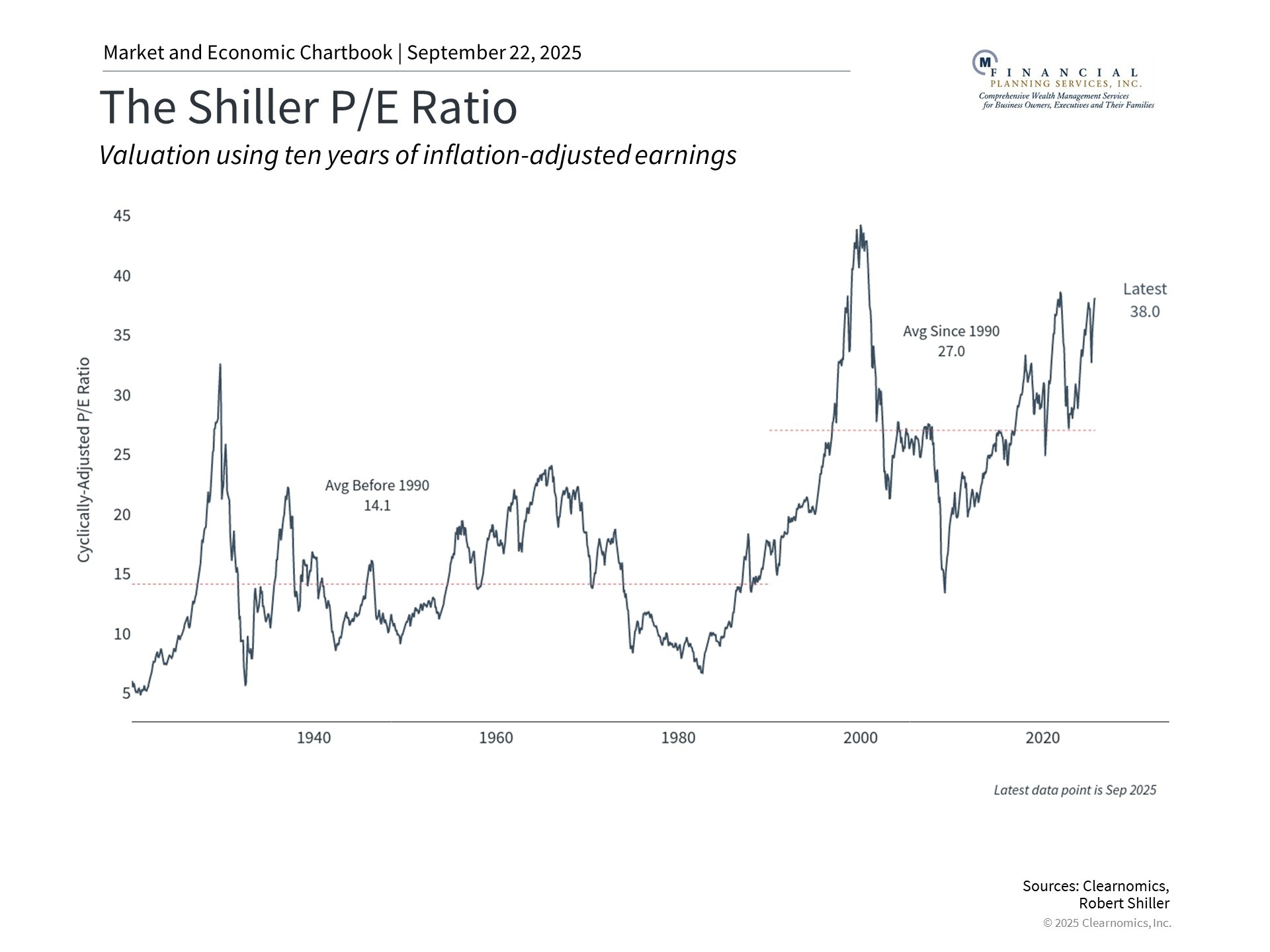
To tell the difference between short-term drops and real bubble fears, we need to look at value. In investing, what matters isn't just the price you pay but what you get for your money. When you buy stocks, you own part of a business and its cash flows. Valuation metrics like price-to-earnings ratios tell us not just the stock price, but what we're getting for that price.
The chart shows the Shiller price-to-earnings ratio. This looks at long-term valuation trends using inflation-adjusted earnings over ten years. The current level is 38x, meaning investors pay $38 for each dollar of past earnings. This is well above the average of 27x.
Even though stocks look expensive by historical standards, here are key points to remember. First, valuations don't reliably predict short-term stock returns. They show how much investors are willing to pay based on their future expectations. Even when stocks seem expensive, markets can keep rising for months or years if businesses stay strong.
Second, today's situation is different from the 1990s tech boom. Back then, many dot-com companies made no profits. Today's market leaders are established companies with strong profits and healthy finances. Just like the internet revolution helped all types of companies over decades, artificial intelligence could do the same.
Investment opportunities exist in different areas
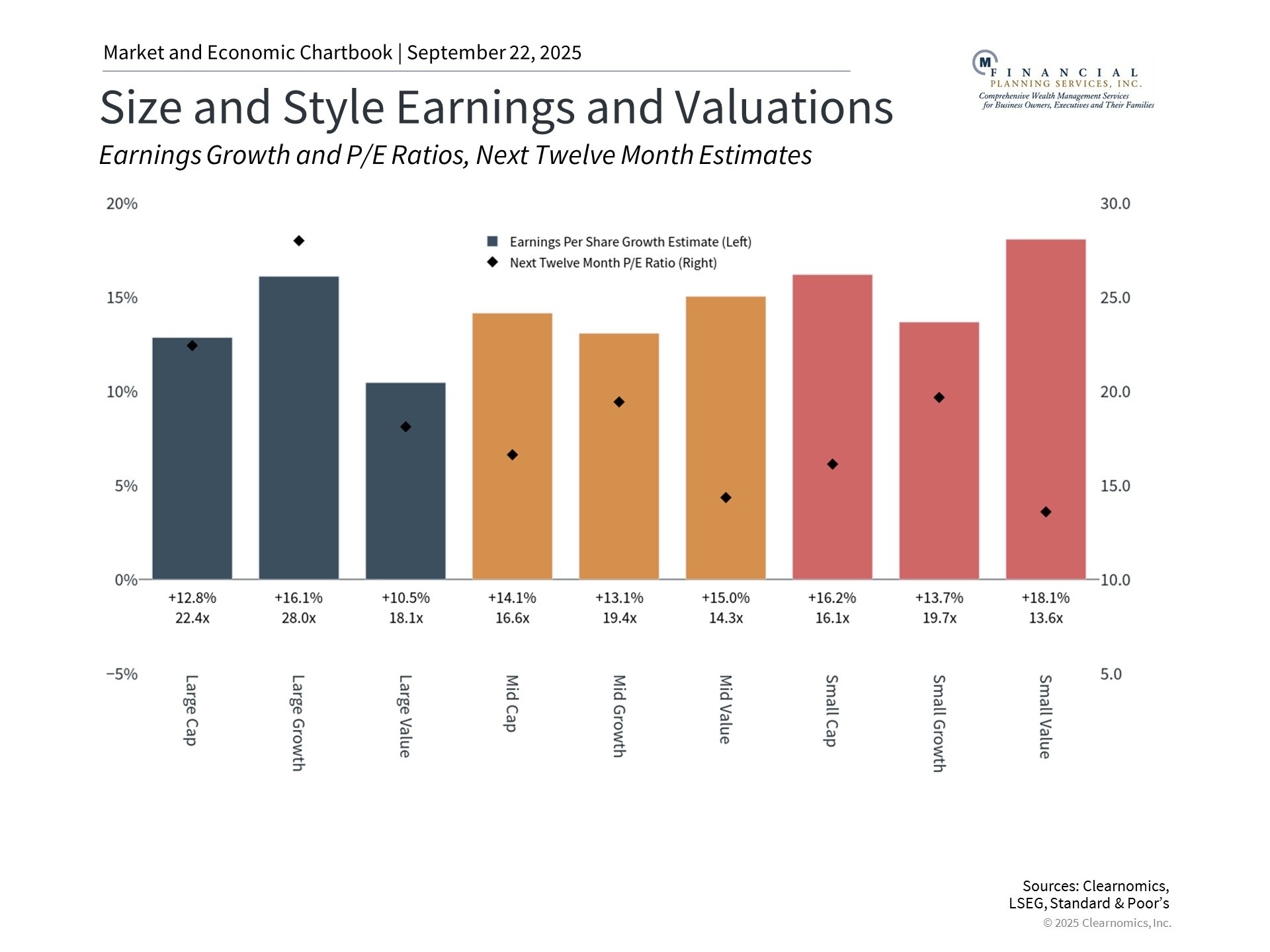
While the broad market looks expensive, other areas are more attractive. The chart shows that Large Cap Growth stocks have the highest price-to-earnings ratio at 28x. Other stock categories like Large Value and Small Cap stocks have better valuations while still showing healthy earnings growth.
This is also true across different sectors. AI-related companies are mainly in Technology, Communication Services, and Consumer Discretionary sectors. Recently, positive trends have spread to other sectors with better valuations, including Financials and Industrials.
For investors, including different sizes, styles, and sectors in your portfolio helps reduce "concentration risk." This means not putting all your money in one area. It can also improve your overall valuations to better manage risk. It's hard to predict which areas will do best, so holding a good mix helps balance your portfolio.
Time is your most powerful investment tool
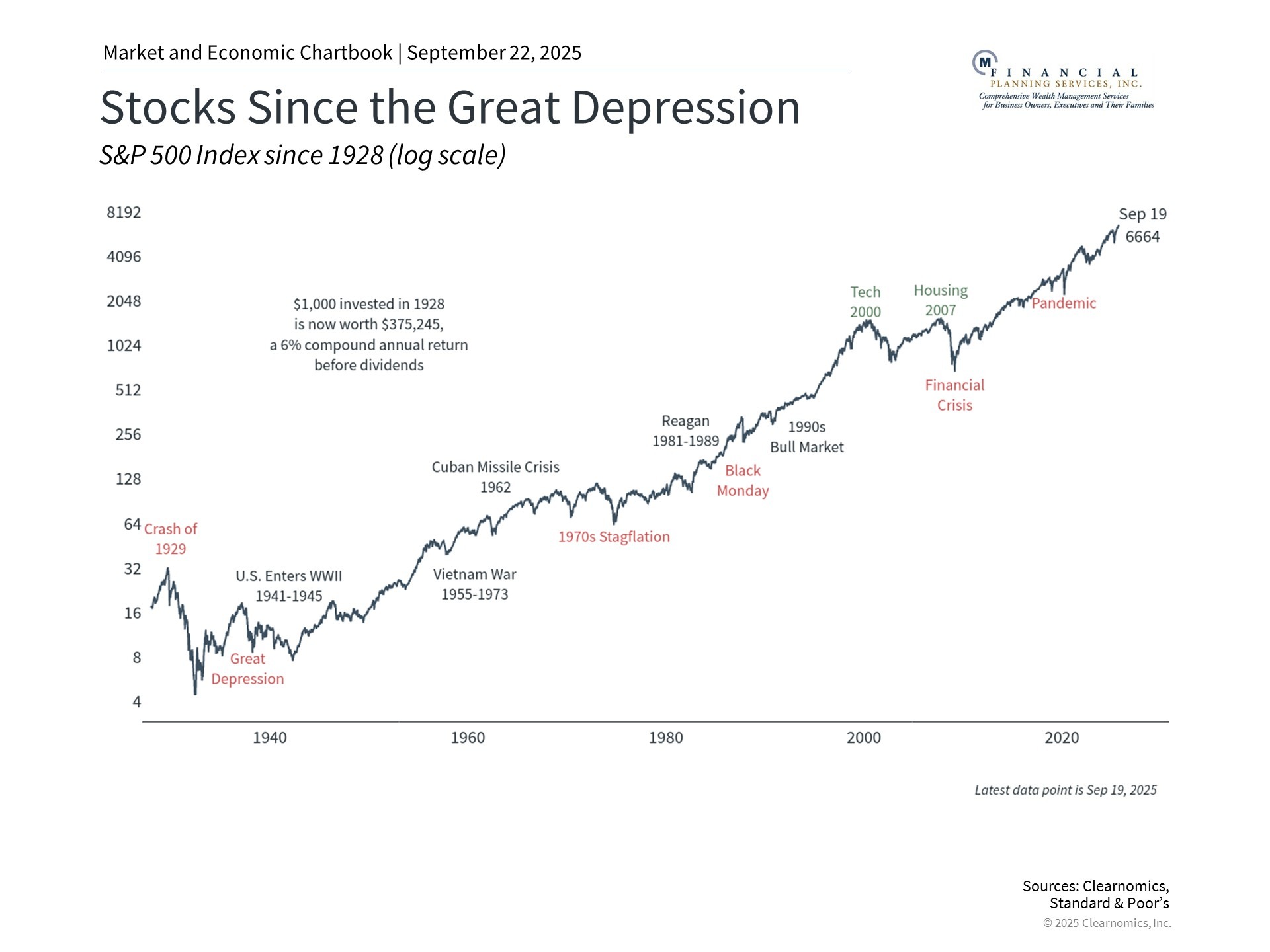
The most important lesson from market history is that time rewards patient investors, even those who invest during high valuations. The chart shows that major market events look less dramatic when you zoom out over years and decades. The tech and housing bubbles, while difficult at the time, both recovered as markets reached new highs.
This shows why portfolio positioning and long-term investment strategies like dollar cost averaging are important. Dollar cost averaging means investing the same amount regularly over time. Even people who invested at the worst times in history, like the 1929 market peak before the Great Depression, made positive returns over time.
The bottom line? Today's high market valuations come from strong earnings and solid business fundamentals. The key is keeping a diversified portfolio that can benefit from growth while managing risk.
The content is developed from sources believed to be providing accurate information. The information in this material is not intended as tax or legal advice. Please consult legal or tax professionals for specific information regarding your individual situation. The opinions expressed and material provided are for general information, and should not be considered a solicitation for the purchase or sale of any security.
Dollar cost averaging involves continuous investment in securities regardless of fluctuation in price levels of such securities. An investor should consider their ability to continue purchasing through fluctuating price levels. Such a plan does not assure a profit and does not protect against loss in declining markets.
All investing involves risk including loss of principal. No strategy assures success or protects against loss. There is no guarantee that a diversified portfolio will enhance overall returns or outperform a non-diversified portfolio. Diversification does not protect against market risk.
The prices of small cap stocks are generally more volatile than large cap stocks.
The Standard & Poor’s 500 Index is a capitalization weighted index of 500 stocks designed to measure performance of the broad domestic economy through changes in the aggregate market value of 500 stocks representing all major industries.